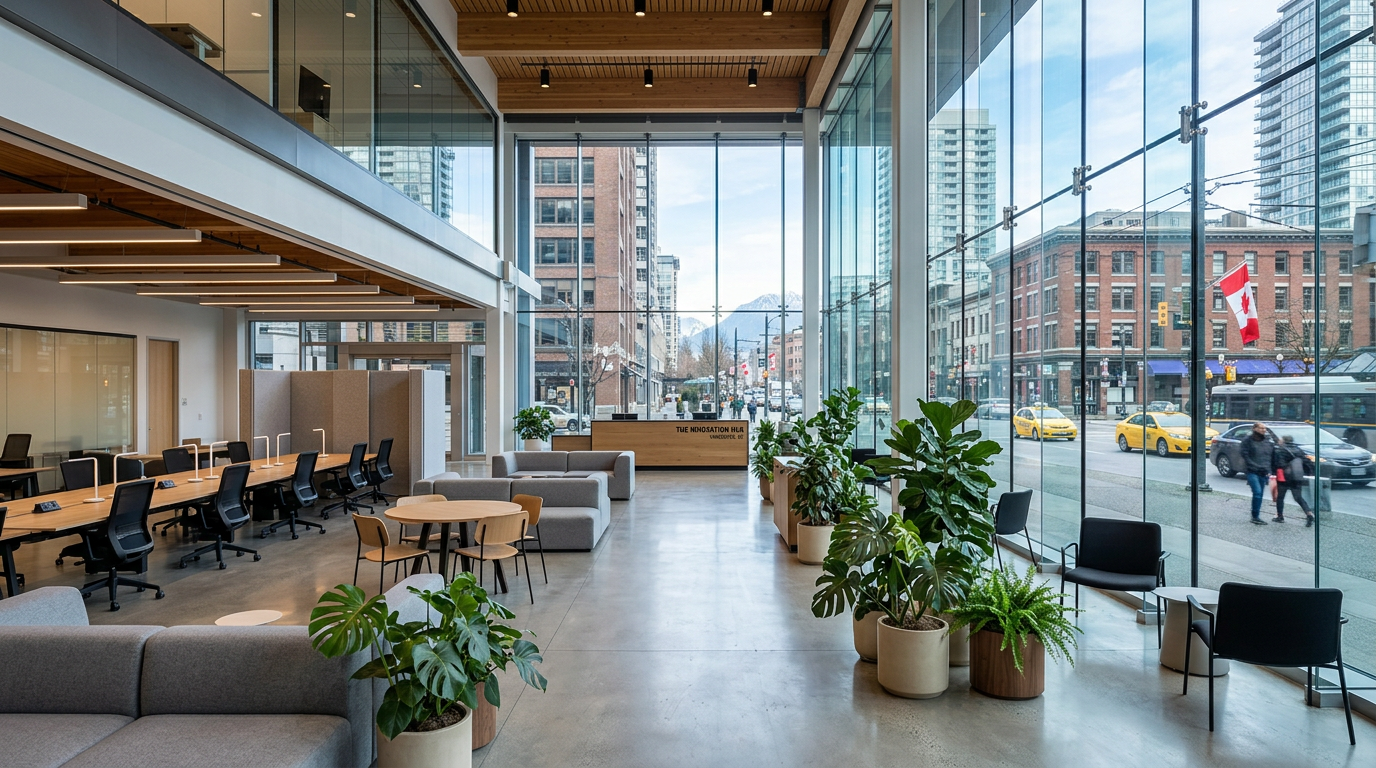
The evolution of workplace practices is continuing to reshape Canada's commercial real estate landscape, as organisations across the country settle into hybrid working arrangements that now appear permanent rather than transitional. What began as a crisis response in March 2020 has become a structural shift — one that is forcing landlords, developers, city planners, and workers themselves to rethink assumptions that had held for decades.
The Numbers Behind the Shift
The data tells a consistent story. Statistics Canada's most recent Labour Force Survey found that approximately 40 percent of employed Canadians are in occupations that can be performed remotely, and of those, roughly two-thirds have adopted some form of hybrid arrangement. Fully remote work has stabilised at around 15 percent of the working population — lower than its pandemic peak but significantly higher than the pre-2020 baseline of less than 5 percent.
National office vacancy rates, according to data from CBRE Canada, reached 19.1 percent nationally in Q4 2025 — the highest since the early 1990s recession. Downtown Toronto, Canada's largest office market, has stabilised around 16 percent vacancy after peaking above 18 percent in 2024. The picture varies significantly by building quality: premium Class A space in well-connected locations is performing considerably better than older Class B and C stock, which faces functional obsolescence as much as vacancy pressure.
What Offices Are Now For
Surveys of Canadian employers consistently show that the majority have adopted flexible working as a standing policy — not a temporary accommodation. The effect on office space is not simply a reduction in square footage leased but a fundamental rethinking of what an office is for. The shift is away from rows of assigned workstations toward spaces designed for collaboration, client engagement, team culture, and the kinds of informal interaction that video calls cannot replicate.
In Toronto's Financial District and downtown core, vacancy rates remain elevated, but premium office buildings with modern fitouts continue to attract tenants willing to pay for quality. The flight-to-quality trend is particularly pronounced among professional services firms in law, financial services, and technology, several of which have consolidated from multiple floors to a single well-designed space, often reducing their overall footprint while improving their address and amenities.
City by City
Toronto
Toronto's Financial District has seen the most dramatic vacancy increases, driven by the concentration of financial services and professional firms that were among the first to move to hybrid models. The entertainment and hospitality businesses that depend on the lunch-hour and after-work trade from office workers have been materially affected. The city has approved several conversions of older office towers to residential use — a trend that is accelerating as the gap between residential and commercial property values in the core widens.
Vancouver
Vancouver's office market has been partly cushioned by the presence of large US tech company offices — Amazon, Microsoft, Apple, Google — that have continued to invest in space despite industry-wide headcount reductions. The city's shortage of purpose-built office stock in some submarkets has also meant that vacancy, while elevated, has not reached the levels seen in Toronto. The suburban office markets of Burnaby and Surrey have seen increased leasing activity from companies relocating to be closer to where their employees actually live.
Montreal
Quebec's capital has benefited from a combination of lower pre-pandemic office rents, a strong gaming and tech sector that requires collaborative work environments, and provincial government policies that have kept more public sector workers in physical offices than in other provinces. Downtown vacancy is elevated but the conversion of older buildings to residential and mixed use has proceeded more quickly than in English Canada, partly due to the city's strong planning framework for adaptive reuse.
Calgary
Calgary presents a more complex picture, as its office vacancy challenge pre-dates the pandemic — a consequence of the 2014-2015 oil price collapse that sent energy companies downsizing their downtown footprints. The remote work shift has added to this existing oversupply, but the city's aggressive Downtown Development Strategy, which has committed over $200 million to office-to-residential conversions, is beginning to reduce vacancy in the core through supply reduction rather than demand recovery.
The Rise of Suburban and Secondary City Demand
Analysts see the remote work shift as long-term, with flow-on consequences for transit ridership, inner-city retail, and the relative appeal of mid-size cities and suburban communities. Towns within driving distance of major centres — or simply reachable by reliable broadband — are reporting increased population interest and rising residential property demand. Cities including Guelph, Kingston, Kelowna, and Moncton have seen above-average population growth since 2020, driven partly by workers who have discovered they can live in a more affordable, lower-density community without sacrificing career access.
The implications for commercial real estate extend beyond downtown cores. Suburban co-working spaces and flex offices have grown strongly, serving employees who want to work outside the home without commuting to a city centre. Major co-working operators have expanded their suburban and secondary market footprint considerably, and several traditional office landlords have begun offering managed flex space as part of their portfolio.
What Workers Actually Want
The persistent tension in the Canadian workplace is between employees who have reconfigured their lives around flexibility — buying homes in different markets, caring for children or parents during working hours, building local community connections — and employers who see value in in-person collaboration and culture. Survey data consistently shows that most Canadian workers prefer a hybrid model: two to three days in the office, the remainder at home or elsewhere.
Mandated return-to-office policies have met with resistance and, in several high-profile cases, attrition. Canadian tech companies that announced full return-to-office requirements in 2024 reported difficulty retaining staff who had built their lives around location flexibility. The professional services sector has generally settled on a three-day-in-office norm for client-facing roles, with more flexibility for back-office and technical positions.
The Long View
Commercial real estate analysts broadly agree that the next five years will see continued adaptation rather than a simple return to pre-pandemic patterns. The buildings that thrive will be those designed for the kind of work that benefits most from in-person presence — intensive collaboration, client engagement, mentoring, and the cultural transmission that happens through informal proximity. Buildings that offer nothing beyond desk space will continue to struggle.
For Canadian workers, the shift represents a genuine quality-of-life improvement — shorter commutes, more flexibility, and greater control over working conditions. The challenge for cities is to adapt their infrastructure, zoning, and economic base to a pattern of movement and settlement that looks quite different from the one they planned for.